Wednesday, 4 April 2012

The Falling Leaves by Margaret Postgate Cole


Margaret Postgate Cole

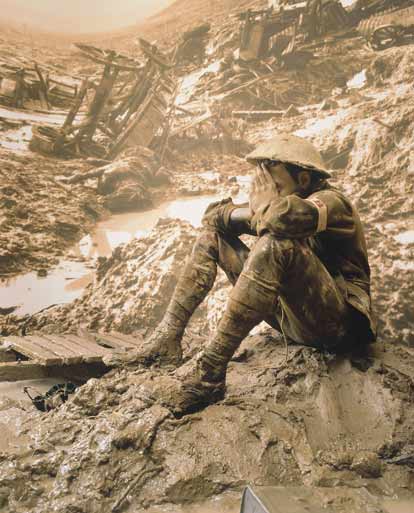
Margaret Postgate Cole was a pacifist, and this poem seems to reflect something of her feelings towards the First World War. Written quite early in the war, it still reflects a sense of the trememdous waste of life in the trenches. Written and set in autumn, it parallels the death of the leaves on the trees to the deaths of the soldiers in war, both in quantity, and implicitly in the way in which they are now so common as to have become part of the landscape. The image of dead men falling as thick as 'snowflakes' should be shocking, but instead creates a powerful sense of the transience of life.

The poem's form is not quite a sonnet (glad you counted the lines anyway!) but has a two-part structure that might remind us in some ways of 'Futility'. In the same way as that poem, the two parts of the poem seem to echo each each other and develop the ideas within it. Here, there is a repeated rhyming scheme: ABCABC DEFDEF which accentuates the ways in which the two halves of the poem reflect on each other. The general metre is iambic, with some notable exceptions, such as the anapaestic dimeter of line 3 (in a still afternoon) and every second line is a pentameter, giving a hesitant, almost broken effect to the speaker's tone, as though ideas and lines are left incomplete, and as though there are long pauses for thought. The poem is actually one long sentence (might this remind us of the long, unbroken but jumbled speech of 'next to of course god america i'?), something which contributes to this sense of pensive, layered speech, as though each clause were an additional small thought added to the central idea.

The poem opens with a fairly jaunty iambic trimeter followed by a pentameter which seems to enact the steady beat of a walking horse introduced as an idea in the first line 'today as I rode by', with the internal rhyme between 'leaves' and 'tree' created by the assonance on those long vowels emphasizing the slow pace of the poem, further flowed by the anapaestic line 4 (interesting to note that this is the reverse of the fast dactylic rhythm of 'The Charge of the Light Brigade', though it shares something of the same feel of hoofbeats). I'm suggesting that it is a horse here, partly because of the date--at this time, cars were not so common--and partly because the whole poem seems to me to have a slightly archaic feel in terms of language--even for the time of writing, the use of 'thence' or 'pestilence' or 'strewed' or 'slain' seems a little old-fashioned--and so 'riding' in a car or a bus would seem at odds with the mood of the poem. It would also make it more difficult to 'wander slowly themce' unless you got out of the vehicle but that's another story.

Line 4 introduces an interesting image, because its negation of the idea of the autumnal wind ('no wind whirled them') nonetheless vividly calls up the idea of the wind, the alliteration on 'w' turning the line almost into a tongue-twister which has to be spoken slowly. The idea that the leaves are not  'whirled..to the sky' may also be a subtle reference to Postgate Cole's atheism--she does not believe that the dead soldiers are going to be restored, or are going to heaven--once they fall, that is where they stay,'withering'. The 'dead rhyme' of 'afternoon' and 'noon' contributes to the deadening effect of this first part of the poem, the leaves falling 'thickly, silently' suggesting the numbers of fallen men and the ways in which their deaths seem to be unnoticed by most of the public.

This poem, as we discussed in class, plays with two semantic fields--one is the pastoral semantic field of autumn and nature, and is established in the first half of the poem, and the second is the semantic field of death and war, introduced in the second half of the poem. Particular words and phrases in the second part of the poem echo the first half, and make us look at it again perhaps in a different way, so the 'no wind' in l.4 is repeated as 'no wind of age or pestilence', and the simple simile 'like snowflakes' in l.6 becomes extended to 'like snowflakes falling on the Flemish clay' at the end of the poem. If you need reminding of how semantic field work, look again at Pink and her song 'Just Like a Pill' which creates its sometimes shocking effect by mingling the semantic fields of drug abuse, hospital care, and romantic love


The poem is deceptively simple. The analogy between the men and the leaves is so direct that the poet hardly needs to enlarge it--once the thought is introduced in line 8, with the mention of the 'gallant multitude', each succeeding line seems to layer more weight on the idea, until the men and the leaves become interchangeable in their 'beauty' both 'withering' alike in England or in Flanders. The trochee that starts line 10 emphasises the word 'slain' by stressing it, and also stresses that we never in this poem find out what it is that has 'slain' the men. There is no mention of bullets or bombs; they seem to die as naturally and inevitably as the falling leaves themselves. the poem is very different to those of Owen or Sassoon (though actually, not so different to 'Futility', which also doesn't go into gory detail), and reflects Postgate Cole's distance from the experience of the front lines. The soldiers who die here are seen in an almost Rupert Brooke-like way, as forever young and forever beautiful, 'like snowflakes'--perfect but transient as they 'melt' into the clay of Flanders. If you were being very attentive here, you might remember the idea of 'clay' in 'Futility' again, and think of this further connection between the two poems.

This poem is one of the few in the 'conflict' cluster that comes from a poet writing during The Great War that is, World War 1, from 1914-1918). As such, it is an interesting comparison  to Owen's perspective on death in 'Futility' (which might suggest that the death of soldiers in war is pointless), and the earlier writing of Tennyson in 'The Charge of the Light Brigade' (which might suggest that the death of soldiers in war is heroic). Postgate Cole seems to almost take a middle view--the poem suggests that the soldiers who die are 'gallant', and has none of the bitterness you occasionally get from Owen and Sassoon, but instead focuses on a simple image of falling leaves, through this image expressing a sense of sadness and loss at the deaths of the fallen

Tuesday, 3 April 2012

Futility by Wilfred Owen

If you follow my rule for looking at poems you don't know and counting the lines to check if it's a sonnet, you will see fairly sharply that this is possibly a sonnet--though what makes it interesting is that it isn't quite what you would expect from an ordinary sonnet. Most sonnets have 14 lines and a complex rhyming scheme, they are generally in iambic pentameter, deal with personal emotion, pose a question, or announce a problem (eg 'My mistress's eyes are nothing like the sun' or 'Since there's no help, come let us kiss and part') and then end in a resolution or solution (eg 'and yet by heav'n, I think my love as rare /As any she belied by false compare', 'from death to life thou mightst him [love] yet recover').
This poem has 14 lines all right, and a complex rhyming scheme, but it is not in iambic pentameter, and it does not seem to divide up naturally into an octet and a sestet, nor does it have a 'turn' either at line 9 (like a Petrachan or Italian sonnet) or just before a final couplet (as a Shakespearean or English sonnet would). Instead it has two apparently 'mirrored' stanzas of 7 lines each, and in some ways defys the sonnet form--enacting its title and finding no solution to the problem posed, but rather an increased sense of frustration or futility. This sense that it is in some ways a 'static' sonnet is interesting, I think, because I suspect it is a deliberate choice by Owen.

The poem briefly recounts an incident in the war--a soldier is found in the morning to have died overnight in his bunk in the trenches. Moving him (quite practically) out of the sleeping area provokes a thoughtful meditation on the pointlessness of war. Although we are not explicitly told what has killed the soldier, the implication that he has been unharmed 'until this morning, and this snow' might lead us to think that he has died of exposure and cold. One of Owen's other well-known poems is called 'Exposure', written in 1917 (the year before 'Futility') and this vividly depicts the cold endured by the troops, something which might make you lean towards this reading. In 'Exposure', the very thought of the sun seems almost like a touchstone against the cold. Owen suggests that the reason that they endure the misery of cold and ice in the trenches is, in effect, to keep the home fires-and the sun-- burning:


 We turn back to our dying.


Since we believe not otherwise can kind fires burn;
Nor ever suns smile true on child, or field, or fruit.


This thought seems to be echoed in 'Futility', except here the sun which implicitly smiles on children back at home is asked to shine on the man who has died.


The poem starts with an imperative--one that could be seen as a simple command--but the use of 'gently' immediately turns the simple act of moving the body into a gesture of tenderness. the sun is immediately personified with the ideas of 'its touch...whispering', and this personification is developed into the idea of 'the kind old sun' seeming to echo both the 'kind fires' and the 'suns smile true' of 'Exposure'. It is implied that the soldier used to be a farmer--someone who woke with the dawn, knowing that there was work to do, with 'fields half-sown'--an image of growth and new life that is also developed in the poem. The soldier, we are told, stayed in the habit of waking with the sun 'even in France', and the plaintive 'always it woke him' seems to emphasise the central fact that he will never wake again. Throughout the poem, Owen plays with the word:  'awoke...woke...wakes...woke' (in a rhetorical figure called polyptoton), with a move into the present tense at the start of the second stanza that seems to promise progress and resolution--until it is disappointed (interesting that the sound is also caught up with the internal rhyme with 'break' in the final line of the poem).


The half-rhymes, or pararhymes 'son/sown', 'once/France' are very typical of Owen and create a subtle effect whereby the tone of the poem seems conversational, the long vowels contributing to the gentle effect of the first stanza. The second stanza, by contrast, seems harsher, with the move into the present tense accentuated by the imperative 'think' and the harsh 'k' alliteration (think..wakes...woke...clays...cold') alternating with sibilant 's' sounds and shorter vowels to speed the poem's pace.


This increasing pace leads up to the series of questions that form the climax of the poem. The image of the sun's power to bring life to 'the clays of a cold star' (to draw life from the earth) suggests that it is being lazy or uncaring in not waking up the man (I'm tempted to think here that he is half-remembering John Donne's poem  'The Sun Rising' which starts: 'Busy old fool, unruly Sun, /  Why dost thou thus,/
Through windows, and through curtains, call on us ?') The bitterness of the question 'Are limbs...sides...still warm too hard to stir?' implies the answer 'no, they are not' and yet we know rationally that the sun cannot awaken a dead man, increasing the sense of frustration felt.


The image of 'clay' picks up on the traditional idea (in the book of Genesis) that mankind was made by God from the earth (the word 'Adam' comes from the same root as the word for 'earth' in Hebrew, and is also connected to the word for 'red', meaning that Adam was seen to have been created out of red earth, or clay). Of course, clay also needs heat if it is to become a creation of pottery; 'cold clay' is opposed to life and creativity in this sense. The idea that 'the clay grew tall' refers to the idea that mankind has gained ascendancy over the world--'taller' in effect than the rest of creation. Here. the question is clearly bitterly rhetorical--the implicit answer is 'no, mankind did not develop just for this--for war for death and destruction--and yet of course death is ultimately the end of all human beings, no matter how beloved or accomplished.


Owen's final bitter question changes his attitude to the sun completely--now the sun really is 'foolish' as Donne suggested, it is 'fatuous' and idiotic, working pointlessly 'to break earth's sleep'. By the end of the poem, Owen finds no resolution, but only a deeper frustration.


'Exposure' ends:


To-night, this frost will fasten on this mud and us,
Shrivelling many hands, puckering foreheads crisp.
The burying-party, picks and shovels in shaking grasp,
Pause over half-known faces. All their eyes are ice,
             But nothing happens.


'nothing happens' being the phrase that ends each stanza, and again this seems to be echoed in 'Futility'.


Kenneth Simcox has a thoughtful reading of the poem at the Wilfred Owen Association which is well worth a look.


Monday, 2 April 2012

Mametz Wood


Mametz Wood, by Christopher Williams
This poem was inspired by a real incident, where the poet visited this battlefield of the Somme, and found unearthed the grave of twenty soldiers, buried with their arms linked--an extraordinary image in itself, and one which accounts for the shift in the poem from 'years afterwards' to 'now' and 'this morning'--a lexical trick which gradually brings the poem sharply into the present, though it is about the past. The form of the poem is interesting, consisting of three-line stanzas (called tercets) which create the impression of a series of connected, quiet thoughts. Many lines are end-stopped, or appear to be at first sight though on reading we can see how the thought often carries beyond the initial idea, seeming to expand what initially seemed to be a complete thought in the next line (as in 'the farmers found them--/ the wasted young'). There is the occasional striking use of enjambement which breaks a sentence over two stanzas (as in the blown/ and broken bird's egg of a skull/ all mimicked now in flint', seemingly enacting the fragmentation of the dead soldiers' bodies in the fragmentation of the lines.
 
The poem draws on a tradition of poems about this WW1 battle--Sheers visited the site when researching the poet David Jones (wounded at Mametz Wood), whose 'In Parenthesis' is one of the greatest long poems of this or any war (for more about 'In Parenthesis' look at Tim Kendall's War poetry blog, which has a really interesting discussion about Jones, and his connection to Sassoon).

The poem that really resonates here for me, though, is Robert Graves, 'A Dead Boche'. Graves also fought at Mametz wood, and his memory of the battle is a gruesome one, from the aftermath:

A Dead Boche

 To you who’d read my songs of War
And only hear of blood and fame,
I’ll say (you’ve heard it said before)
”War’s Hell!” and if you doubt the same,
Today I found in Mametz Wood
A certain cure for lust of blood:

Where, propped against a shattered trunk,
In a great mess of things unclean,
Sat a dead Boche; he scowled and stunk
With clothes and face a sodden green,
Big-bellied, spectacled, crop-haired,
Dribbling black blood from nose and beard. 


The description Graves presents here is so very far away from the clean 'china plate...bird's egg' imagery of Sheers, it seems to me almost like Sheers is creating a deliberate contrast, and one which accentuates the time that has passed since the battle. his final image, of the singing skeletons, brings a touch of joy and almost healing humour to the grim image of the mass grave.

The picture that he presents throughout the poem, of farmers unearthing pieces of bodies as they plough, is made tender by the semantic field that he uses. Not only do you have the naturalness of 'tended...bird's egg...nested' (with connotations of boys searching for bird's eggs? a common occupation at the time of WW1), but also the sheer ordinariness of the 'china plate'. There's a contrast within the poem, of language which is positive, even life-enhancing with that which destroys, so that you can almost feel the vulnerability of the broken skull within the image of the men 'told to walk, not run /towards the wood and its nesting machine guns'. In this line, for instance, the enjambement creates a little pause before 'towards the wood' which echoes the preceding pause of 'walk, not run', creating a sense of movement and hesitancy, and the association of 'wood' and 'nesting' seems to have us back in the semantic field of birds for a moment before the awful realisation of 'machine guns' at the end of the line. It's interesting that this line also gives us one of the two rhymes in the poem, the other coming at the end, the couplet 'run/guns'.

The personfication of the earth which 'stands sentinel' creates an extended metaphor of the wounded land 'reaching back into itself', a phrase which echoes the first line where the farmers have 'tended the land back into itself'. This sense of retrospection, of thinking back and feeling the past as a vivid reality is made clearer by the image of 'a wound working a foreign body to the surface of the skin'. The phrase is also, of course, a rather dark-edged pun, or play on words--since the poet is talking literally about bodies which are foreign to the land. We might think here about Rupert Brooke's famous sonnet starting: 'If I should die think only this of me /That there's some corner of a foreign field/That is forever England'. Sheers is perhaps thinking of a similar image.

File:Holbein-death.pngThe description of the mass grave as 'a broken mosaic of bone' continues this tendency to see the dead as something archaeological (it might be more usually Roman remains one might turn up with a plough), and makes them appear something like an artefact (an idea reinforcd by Sheer's own comment 'whoever had buried them had taken the time to actually link their arms'). The image suggested is also one of the traditional late-medieval danse macabre where a dancing skeleton or skeletons, drawing in people from all walks of life, represented how death could strike at the unwary, even in a time of celebration (see left). For a slightly more cheery version of the idea, see the animation below!


If you'd like to read more about Sheers and his composition of the poem, look at the poetry archive site where you can also hear him reading the poem.

Sunday, 1 April 2012

The Right Word

If you search google for 'terrorist', this image comes up first...
This poem is a rather touching expression of how important words are when it comes to thinking about the perpertrators and the victims of conflict. Dharker reads the poem here, at the Poetry Archive site, and on the same site says that she sees the poem as in some ways analogous to a film--in that it is like a single film shot, interpreted in different ways. It's an interesting way of looking at it.

The poem is strructured in a series of short stanzas that seem to use incremental repetition in the same way as a poem such as 'Flag' does.  It is unrhymed, but the repetition, and the author's apparent questioning of her own language seem to hold it together in structural terms. The frist word that she uses, 'terrorist', is a loaded one, as the image on the left suggests, and this sinister effect is accentuated by the use of the verb 'lurked' which has connotations of suspicious activity--someone usually lurks for a nefarious purpose. The form of repetition that Dharker uses here, where the same words frame others that are changed (but which are, for instance, all nouns or verbs) is called parison. It is a very forceful kind of repetition, because the similarity of structure of the clauses makes you extremely aware of the differences in language between each--for instance the shift from 'the door' to 'that door' to 'your door' which has the effect of bringing the person outside closer to the reader as the poem goes on.

This is what google gives as one of the first images for 'freedom fighter'
Stanza 2 starts immediately with self-questioning--'is that the wrong description?', and she then replaces the term and seems to rephrase the idea. The term that she uses in stanza 2 is 'freedom fighter', and here the person is 'taking shelter'--the shadows become protective rather than sinister. As you can see from the image left, a 'freedom fighter' as the name implies, is a very much more positive term with connotations of bravery and heroism that 'terrorist' tends not to have. In fact, many of the images google has are from video games, music covers and so on, suggesting that a freedom fighter is a figure to be admired and emulated. I think myself that it also has a sligthly archaic feel--but perhaps that is only because it tends to be used of people well after the event. It's a definite term of approval, as the use of 'shelter' (suggesting an innocent) suggests.

If you search 'google' for 'hostile militant', this is what you find...
The poet again interrupts herself, with the statement 'I haven't got this right'. The self-questioning again foregrounds the preocess of composition of the poem--the author is creating the effect that the poem is spontaneous, is being written as it is read, almost. The lack of rhyme adds to this effect--it is as though the poem is deliberately 'unpoetic' in tone. The term 'hostile militant' seems to have connotations of news reports; it sounds like an official term, perhaps part of army jargon, while 'waiting in the shadows' suggests someone lying in wait, and so reverses the more positive implications of the previou stanzas.

'Guerilla warrior' from google
The next stanza seems to reflect on this with the image of 'words no more than /waving, wavering flags'. This line is immediately reminiscent of 'Flag', which has a suimilar focus on the importance of language and its connotations. The echoing aliiteration on 'w' and assonance of the long 'a' in 'waving, wavering' makes the two words sound similar, the added 'v' in 'wavering' sounding like a hesitation so that the word almost enacts its own meaning. The terminology shifts again, now a 'watchful...warrior' is described, the term 'guerilla' reinding us of past conflicts (rather like 'freedom fighter')--the word 'guerilla' being one which has been used, for instance, by Marx and Engels, and which has been in use since at least the 18th century. As a result, some people who fought guerilla warfare have in retrospect been seen as freedom fighters--something that the poem is inetrested in.
An Early Christian martyr
The next stanza starts 'God help me', a phrse which suggests the uncertainty fo the speaker in naming what she sees, but also preparing us for the next word in Dharkers list of almost-synonyms: 'martyr'. This word is a very loaded term. If you type it into google images, you come up with a huge range of Christan iconography--pictures of men and women who died for their faith, generally during the persecutions of the Roman empire, but with some later ones. as they were a favourite subject for painters in the Renaissance, this isn't that surprising.  What Dharker is referrring to, though, is the appropriation of this term to cover those hostile to a regime, who are willing to commit acts of violence in the name of their faith.

 It is at this point that she mentions the figure outside the door, for the first time, as a personality: 'I saw his face' and it is at this moment that the poem transforms into something more tender. The would-be martyr or freedom fighter or terrorist is seen simply as a 'child', 'lost' in the shadows. The invitation to come in and eat (reminiscent of George Herbert's poem, 'Love III') in effect defuses the conflict and reveals the apparent threat only as a peaceful 'child', courteous and polite. Perhaps the poem is saying that all apparent terrorists are actually someone's child--or it is highlighting how easy it is to be led into misreading threats by fear--or perhaps a little of both.


Friday, 23 March 2012

The Charge of the LIght Brigade

The poem originated when Tennyson read an account of the battle in The Times  newspaper, published on November 14th 1854. It took place during the Crimean war, in what is now the Ukraine, near the town of Balaclava (and yes, that is where the name comes from--very practical headgear for those cold Russian winters!) As Tennyson says in his poem, over 600 men were involved, and nearly 250 of them were killed or severely wounded.


Alfred, Lord Tennyson
 When you consider what they were actually doing, it seems more amazing that any of them survived. They galloped down a blind valley, with heavy artillery on the left and right of them, towards an emplacement of guns. Amazingly, they did actually manage to attack the gunners when they got there, but in realistic terms the action was a disaster. There are different accounts as to why it was such a disaster--who planned it--involving isseus such as lack of communication, simple failure to realise the range of the guns, or simple mismanagement or hubris on the part of the generals. It was partly the reporting by William Howard Russell that made the charge sound as though it was a victory, or at least as though the men involved in it were noble rather than suicidal--many of the words and phrases that he uses are picked up by Tennyson, and used in the poem. Consier this passage from near the beginning, for instance:

They swept proudly past, glittering in the morning sun in all the pride and splendour of war. We could scarcely believe the evidence of our senses! Surely that handful of men are not going to charge an army in position? Alas! it was but too true - their desperate valour knew no bounds

The use of free indirect speech here (we can hear the peoples' thoughts without 'they said') suggests perhaps the use of 'all the world wondered' at the start of the poem.

The semantic field of the poem is also similar to the Times article, not just in simple terms but in terms of structure. Russell uses words such as 'heroic', 'noble', 'valour', 'spendour' and so on at the start of his acount, but also contrasts this with the effect at the end of the article where we have 'wounded' 'sad', 'dead and dying' instead, something that we see in the poem. Individual exaples of influence are present in the idea  of the sables 'flasing in air', drawn surely from the newspaper's 'Through the clouds of smoke we could see their sabres flashing as they rode up to the guns'  and the image of the 'mouth of hell/jaws of death' surely comes from: 'A more fearful spectacle was never witnessed than by those who, without the power to aid, beheld their heroic countrymen rushing to the arms of death. At the distance of 1200 yards the whole line of the enemy belched forth, from thirty iron mouths, a flood of smoke and flame'.

The above video gives you a sense of what the context of the charge was, and also has some interesting quotations from survivors of the battle.

When you're thinking about the poem, try and concentrate on some of the amazing sound effects that Tennyson creates. He is very fond of alliteration and assonance, and this is something that you should notice. You may also be struck with the rhythm of the poem, which seems to imitate the beat of hooves of a galloping horse. This metre (one strong beat, followed by two weaker beats) is called a dactylic rhythm--remember it, as I do, by imagining pterodactyls over the valley of death. Speaking of death, you might also like to notice the dead rhymes where a word is rhymed with itself, creating a relentless and deadening effect.

The repetition in the opem may remind you of a ballad--and it has something of this feel to it--there is certainly some incremental repetition, where we are gradually informed about more and more as the poem goes on, until, for instance, we finally find that not all the 'six hundred' come back..

Monday, 19 March 2012

'Flag' by John Agard

This poem is a good start to the conflict section of the anthology, as it introduces many of the key themes of the selection.

The poet, John Agard, uses striking imagery throughout which delineates the ways in which a flag is far more than just a 'piece of cloth'--he uses deliberate irony to underplay the significance of the flag. The poem is framed as a series of questions and answers. one voice, apparently innocent, asks 'what's that...?' while clearly referring to a flag. the answering voice says 'just a piece of cloth', but seems to give the cloth magical qualities as it describes the power that it has.

You should notice the three-line stanzas, which repeat not only the initial words each time (this is an effect called anaphora) but also repeat the structure over a series of lines--so that we have a series of verbs (fluttering, unfurling, rising, flying) and then a series of prepositions (in, from, over, across) and than a series of nouns (breeze, pole, tent, field). This effect is known as parison (you might remember it by thinking of comparison) and what it does is increase the build-up of tension as we wait for the final revelation of the significance of the flag.

The casual 'just a piece of cloth' is undercut by the dramatic words which end each stanza, words which seem to connote war and conflict. This is clearly moe than a piece of cloth if it can do such terrible things. There is a deliberate ambiguity in some of the images--the nation on 'its knees' might be kneeling in reverence or in surrender, the 'guts of men' may be bold becasue the men are metaphorically feeling courage, but the mention of the colloquial word 'guts' also has connotations of butchery and disembowellment. (you could even argue that the men have been disembowelled--their 'guts' are feeling bold because they are coming out of their body--though that's a fairly nasty reading--what do you think?) Similarly, the coward is 'dared' to 'relent' which is an odd juxtaposition of words--he is being dared not to be a coward? Or being dared to be merciful, which would be implicitly more cowardly from the point of view of the jingoistic flag-waver? interesting...

Agard likes to read his work aloud, and here it is clear that he is creating two different voices in the poem. One seems almost dreamy, using words like 'fluttering' which have an onomatopoeic effect (do you agree that the word 'fluttering' sounds like sometihg fluttering?) while one is harsher, using a semantic field that suggests warfare and aggression, with assertive verbs 'brings...to its knees...makes the guts of men...dares the coward'. The connection between the innocent 'fluttering' or 'unfurling' and these more powerful verbs is emphasised by the question-and-answer format and by the repetition of 'it's just a piece of cloth' in each central line. It could be suggested that the flag sounds like a bird or butterfly spreading its wings (fluttering, unfurling, rising, flying) which contrasts with the progression through humiliation and conflict to 'the blood you bleed' at the end of each stanza, something which emphasises the difference between the idea of the flag and the reality is what is done in its name.

The flag, it is ultimately made clear, is more important than the men who die under it--it will 'outlive the blood you bleed' and the final stanza finally repeats the title word, indicating the significance of 'just a piece of cloth', and answering the initial series of questions more clearly. The final link between the blinding of conscience and the flag makes it clear where Agard stands on this--he sees the flag as something which enables people to hide behind it, to pretend that they are not responsible for what they do.

You might compare this poem to 'next to of course god america i', which also examines the negative connotations of a certain type of patriotism, or 'The Right Word' which discusses the power words have in other contexts of conflict, or even compare it to 'The Charge of the Light Brigade' or 'Bayonet Charge' when discussing the power that flags, duty and loyalty to one's country have over people.

Thursday, 15 December 2011

Conflict Poetry for the AQA Anthology


Over the holidays, you are going to be able to use this blog as a way of supplementing your work on the English anthology.

As often as I can, I shall be adding a post which goes through and discusses the main features of one of the conflict poems. You need to look for these posts and check the blog regularly for new ones.

When you look at the blog, you can read through the notes for each poem, add to your notes about that poem in the anthology, and then ask any questions that you have via the comments space.

When you return from the Easter holiday, I will check your anthologies to see how you have managed to keep up with this note-taking. You will then be able to use these notes as a revision aid as you approach the exam.