 'The Yellow Palm' (click here to hear the author reading it) is a poem born out of the author's real experiences in Baghdad. Robert Mihinnick discusses the genesis of the poem at length at Sheer Poetry, but one of the most striking things that he says is that 'there's no sign of this poem in my notebooks. I wrote it in my head and put it straight on to a computer'. This process of composition (reminiscent of the ways that poets such as Tennyson were said to compose in their head by reciting the poem over and over again) reflects the ways in which the poem is, quite simply, a memorable poem because it has a strong and repetitive rhythm and rhyming scheme.
The poem takes the form of what Mihinnick describes as 'an audenesque ballad', and its resemblance to a traditional ballad is clear immediately, with a typical rhythmic pattern of one longer and one shorter line (though not the typical ballad four-line stanza). The metre seems hard to determine initially, as the syllable length of lines is very variable--it is probably simplest to think of it as being made up of four-stress lines followed by three-stress lines, so 'As I made my way down Palestine Street / I watched a funeral pass'. It has six stanzas of six lines, each of them with a simple rhyming scheme (ABCBDB) and includes a great deal of incremental repetition, the whole poem being built around the opening line of each stanza: 'as I made my way down Palestine street'. Each stanza seems to introduce positive images (eg lilac flowers, the golden mosque) which are then contrasted with harsher ones (the face of a dead man, blood on the mosque walls)
The street of the poem is actually Al-Rasheed street, which is a major thoroughfare int he city, but Mihinnick uses the word 'Palestine street' perhaps to reference the British Colonial powers who (as in Belfast Confetti) tended to name streets in foreign countries after battles or places in which they had influence. The word 'Palestine' also summons up connotations of Christianity, through the link to palms, perhaps reminding reader of Jerusalem, and Palm Sunday, the commemoration of Jesus's entry into Jerusalem before his passion and death. This frame of reference prepares the reader for a symbolic narrative.
As the poem progresses, the use of parison emphasises the ways in which the speaker's reactions change. All his senses seem to be involved in his perceptions of the city.In the first stanza it is 'I watched...' then in stanza 2 'I heard', progressing to 'I smelled... I met'. There is a sense that he becomes more involved in what happens, reacting to what he perceives, for instance stopping at the door of the mosque to see people at prayer, or giving money to beggars. In this way he becomes more identified with the life of the city, going through a series of traumatic memories and references to events that have injured the people of the city until the final stanza, which suggests a sense of the imperishable sweetness of life.
The first image in the poem, the glass coffin in the first stanza, seems fairy-tale-like to western sensibilities. The only place most of us have thought of a glass coffin would be in the story of Snow White (excuse for a film clip), but they are also associated with saints,and the viewing of respected or sacred bodies. It's not clear here if the image is supposed to be literal, or if the glass suggests the vulnerability of the dead man and his family--in any case, there is a contrast between the glass coffin, which enables someone to see within, and the'face of the man who lay within'--a victim of poison gas, and presumably not a pleasant sight for that reason--Wilfred Owen in 'Dulce et Decorum Est recounts how the face of a man who had died in this way haunted him: 'in all my dreams, before my helpless sight / He plunges at me, guttering, choking, drowning'. The reference here is presumably to the Iraqui Kurds who were killed by poison gas by Saddam Hussein in Halabja--one of the crimes for which his cousin 'Chemical Ali' was executed in 2010 (for more about this episode of Iraqui history, see the website KurdishRights.org)
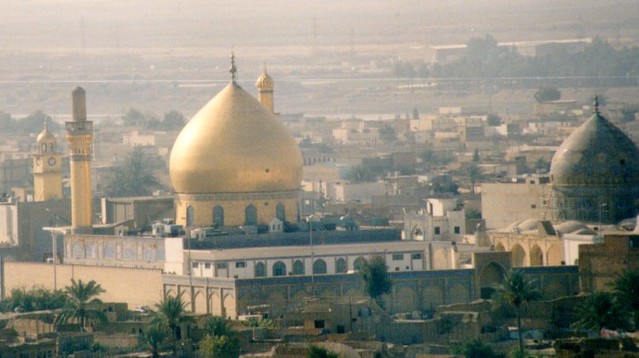 The next stanza deals with a murder in a mosque. Although it would be easy to assume that this references some episode of the gulf war, in fact it refers to a specific event that Mihinnick describes on the 'Sheer Poetry' site:: ' 'Blood on the walls' of the mosque refers to a strange story I heard in Baghdad of invaders of the city who spoke 'a mountain language' (which means a 'primitive' language) murdering one of the boys who helped the muezzin and writing words in his blood on the mosque walls.' The idea suggested, though, is one of war and violence intruding on a peaceful and prayerful situation--that there is something violent behind the apparent peace of the 'faithful' praying at the golden mosque.
 |
| 100 dinar note dating from 1994 |
 battles'(Arabic: أم المعارك umm al-ma‘ārik). The speaker is evidently surprised that these feared troops have sunk so low, reduced to begging on the streets after their injuries.
 |
| The river Tigris as it flows through Baghdad |
 |
| A caravan of camels |
 |
| Cruise missile |
 The final stanza, then, seems to move away from the images of war and of past violence. As thought the child's smile has had a healing effect on 'Palestine street', the speaker now notices, instead of the debris of war and violence, the beauty of the palm trees hung with yellow dates--as he has noted in his notes for the poem, an essential food for the people. The dates fall easily into the child's arms without effort, suggesting the bounty of nature, and the preservation of good things amidst the horrors of war.
You could compare this poem to 'Belfast Confetti', as it also deals with the impact of war on non-combatants (and the street names have an interesting resonance) or in form to 'The Charge of the Light Brigade', or perhaps most easily to 'The Right Word' as it is interested in different perspectives and how they change our view of events.


