Saturday, 7 April 2012

Bayonet Charge


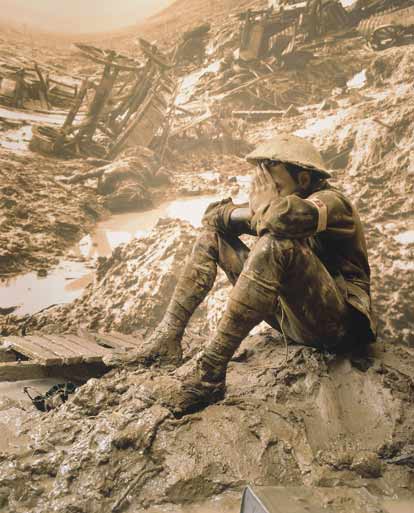
Ted Hughes once said in an interview 'when I first started writing I wrote again and again and again about the first world war', an engagement shaped partly by his admiration for poets like Wilfred Owen, partly by his father's experiences in the war at Gallipoli, and partly, according to his own report, by the West Yorkshire countryside of his childhood, which he reported as 'in mourning for the first world war'. You can read a fuller account of Hughes's engagement with the war in Fighting Back Over The Same Ground: Ted Hughes and War, but for the moment it is enough to know just that at the start of his writing career, he experimented a lot with this kind of pseudo war-poetry, living himself into the role of a WW1 soldier. I call it pseudo war poetry because although it imitates quite well the poetry of masters like Owen and Sassoon, it does not have that edge that the poetry borne out of real experience seems to have--something Hughes himself later came to admit.

The poem is in three stanzas, the first and last of eight lines, and the second of seven. This unevenness is emphasised by the enjambement between stanzas, which the punctuation (particularly the parenthetical dashes of lines 8 and 9) emphasises. The lines vary in length but are about ten syllables long, with little regularity of metre or length, something that adds to the colloquial feel of the speaking voice, the poet seeming to recount a dream or a nightmare-like experience, as though caught in mid-account.

Just like 'Belfast Confetti', this poem starts with the adverb 'suddenly'--and in the same way, this gives us the impression that we are plunged into the middle of the action that it describes. The poem is full of participles: 'running.. stumbling... hearing... smacking... sweating' that give it a sense of pace and purpose. we are dragged out of the past tense 'awoke.. was running' into what seems like the present action 'stumbling', enacting the confusion of the central character in the poem.

The 'raw' experience of the protagonist and the 'raw-seamed hot khaki' link together the new recruit and his uncomfortable clothes and the sharpness of his awakening until we are uncertain as to whether this is a real experience or not. The enjambement between line 1 and 2 emphasises the word 'raw' and brings to it the added sense of hurt or vulnerability. He seem literally weighed down by sweat, the wordplay here on 'heavy' suggesting that his fear and effort is a physical weight upon him. The object of the charge is paradoxically pictured as beautiful-'a green hedge / that dazzled'  suggests that he is attracted to it, the following 'with rifle fire' almost creating a sense of bathos as we--with him--realise the danger it represents.

The semantic field of the body resonates throughout the poem, but it is represented by inanimate things that are personified--the 'bullets smacking the belly out of the air', the rifle 'numb as a smashed arm', these imagined injuries making the man in the midst of it seem almost invulnerable by comparison, though the wounds suggested do present a dark threat of what may be in store for him. The 'patriotic tear' of line 7 might remind us of the patriotism in 'Flag' or perhaps 'next to of course god america i' or 'the Charge of the Light Brigade'. Here, it is transformed into an industrial weight of 'molten iron', the machine-like image reinforcing the unnaturalness of the experience of the charge, and the effort it represents. The 'catch in the throat' of tears here becomes the real pain of breathing heavily when running, the pain 'like molten iron' as Hughes uses hyperbole to get his point across.

In stanza two, the transformation of patriotism to pain seems to impel the hesitation of the man 'in bewilderment then'. The forces propelling him--presumably states, government--are seen as 'cold clockwork'; both fate and powers simply beyond his control. He is seen as the moving hand that the clockwork causes to act 'pointing that second', but the self-questioning causes him (unlike the soldiers Tennyson describes) to pause. He seems to see himself at this moment, running like someone who has been awakened out of fear, 'jumped up in the dark' (here surely a symbolic dark--he has run into the battle without questioning what he is fighting for) and is 'listening between his footfalls for the reason'. The image suggests someone who is being chased, and of course he is not being chased, but has simply started to charge, he is the one running towards the guns--and this makes him pause. again he seems like something inanimate, a statue, frozen in movement while he thinks about what he is doing. The strong caesura in the middle of line 15 emphasises this pause, as does the shorter stanza.

The poem sets off again with the strongly sibilant line 'then the shot-slashed furrows/ threw up a yellow hare'. The hare--traditionally a swift-moving animal who could easily outrun a man--is here passive, 'thrown up' by the earth, and instead of running, it 'rolled like a flame / And crawled in a threshing circle'. Against the 'clods' of the field across which the soldier runs, it seems brightly coloured (like the green hedge--or like the flame it resembles in movement?) and yellow (Hares are usually a light brown colour--but this hare may be more the colour of a golden Labrador) It seems to be clearly injured, the word 'threshing' particularly suggesting its pain, but it is silent, and the horrible silent scream suggested by 'its mouth wide/ Open silent' seems to foretell the soldier's fate if he stays still. Hares often rely on their colour to camouflage them against predators, and will therefore lie still in fields unless disturbed,when they run in their characteristically zig-zag fashion to elude pursuit (like a soldier trying to dodge bullets, one might think). Have a look at this clip of hares being hunted by golden eagles (don't worry, the hares escape) to get an idea of how fast they can go. For Hughes (and more importantly, for the soldier he is writing about ) a running hare like this would have been a familiar sight--the hare wounded and thrashing about on the ground, would have been a very vivid reminder of what injury you could get by staying still.

In the final stanza, the soldier moves again: 'plunged past' the hare. The very 'plunged' here reminds us perhaps of the gassed soldier in 'Dulce and Decorum Est'-- 'he plunges at me', but more powerfully--as does this whole poem--reminds me of Owen's poem 'Spring Offensive'.  This poem has also the grass and the attractiveness of the green along which men race 'exposed'--and also describes how they 'plunged' toward death and how they 'crawled' back--well worth a read to really see where Hughes was coming from.
Hughes here describes how the soldier drops everything--like someone running for their life would drop 'luxuries', he here drops 'King, honour, human dignity'--in other words, drops that 'brimming tear' of patriotism. Abstractions here seem like real possessions, abandoned in the face of reality. Here, finally, only 'alarm' fuels his run, like the hare running from hounds. The final image of the poem suggesting how the air becomes electric, his terror like a bomb about to explode, the vivid 'blue' like the earlier 'yellow' and 'green' seeming to sharpen the image.

The poem actually ends with this panic, the 'terror's touchy dynamite' crackling and about to go off--like the start of the poem, it seems abrupt, as though we have seen just a section of an experience, perhaps only partly understood. For an interesting reading of the poem, look at Tim Kendall's War Poetry blog. Despite his unkind words about the anthology, or perhaps because of them, he makes some good points about this poem.




Friday, 6 April 2012

Hawk Roosting

At first glance, you might wonder what this poem is doing in the 'conflict' section of the anthology--in fact, you might wonder about that at second glance as well. It might be suspected that the compilers of the anthology have not read Ted Hughes's 1970 interview when he commented on the poem:
'The poem of mine usually cited for violence  is the one about the Hawk Roosting, this drowsy hawk sitting in a wood and talking to itself. That bird is accused of being a fascist...the symbol of some horrible genocidal dictator. Actually what I had in mind was that in this hawk Nature was thinking. Simply Nature. ..." (from The Cambridge Companion to Ted Hughes  By Terry Giffor, p.30).


What Hughes points out here is that the apparent viciousness of the hawk has in it a kind of innocence that is quite removed from the ways in which mankind approaches violence. the hawk is no more in conflict with the animals that he hunts than he is with the tree he roosts in--he simply does what he was created to do, and in this sense is not something that is good or evil, even if, as Hughes admits later in the same interview"he sounds like Hitler's familiar spirit". The point is, as he says when discussing his poem 'Thrushes', (which also deals with birds killing) that these animals who kill are innocent: "Their energy affirms the divine law that created them as they are" (p.31). The poem seems to be longing for a moral clarity that relies on the simplicity of knowing who we are and why we do what we do. As opposed to the soldier in 'Bayonet Charge' who pauses precisely because he does not know or remember why he is fighting, the hawk has 'no falsifying dream' of patriotism to rationalise its violence. For those of you who have never seen a hawk catch its prey, here is a clip of a goshawk pursuing and killing a pigeon, which you might find helpful in understanding Ted Hughes and his response to the bird. (this always reminds me of those wildlife commentaries where you can feel either sorry for the pigeon or the hawk depending on how it is filmed--here the commentary suggests that the hawk is desperate for a meal, if that makes you feel any better).


The poem is framed as six stanzas of four lines each, with the end-thyme in ll 3-4 of the first stanza (feet/eat) the only clear end-rhyme in the poem. It is a kind of loose free verse, and suggests a stream-of-consciousness style, the hawk's thoughts eavesdropped upon by the poet. There are a lot of end-stopped lines, which give the impression that the hawk is coming out with a series of simple but definitive layered statements, each of which adds something to the picture of the hawk's mind; something accentuated by the often monosyllabic language and the strong verbs: 'I sit...I hold...fly...I kill... I began..I am'. 


Although the hawk represents Nature (with a capital N--the personified force of life rather than just the idea of natural things), there is also a strong sense of personal identity in the poem, with the use of the first person personal pronouns: 'I..my....me....mine helping to structure the poem and hold it together with a constant reminder of the voice of the hawk, and its arrogant, unthinking selfishness (selfishness is the wrong word, because it implies the possibility of unselfishness--the hawk is just being what it is). If you actually count the uses of the personal pronouns in the poem there are an amazing number-- 21 in 24 lines, and if you look at their frequency in each stanza there seems to be a kind of acceleration of their use towards the climactic line 16: 'my manners are tearing off heads': In stanza 1 there are three: 'I...my...my', in stanza 2, there are two: 'me...my', in stanza 3, five: 'My..my..my..I..my', in stanza 4, five: 'I..I..mine..my..my', in stanza 5, two: 'my...my' and in stanza 6 four: 'me..I..my..I'. This use of pronouns makes the poem seem to focus sharply on the hawk and on its interests all the way through--we see the world through its eyes, and although they may provide a distorted mirror, they also make perfect sense.


The poem presents the hawk as apparently passive in the first stanza, 'eyes closed', and so not a threat. The second line suggests how it is not dreaming as people do (how people do dream of things--and how people follow dreams--is something other poems in 'conflict' explore), with the suggested pun on 'inaction' (in-action) making it appear as thought the hawk has two modes of existing--in action or not in action--and doesn't waste time debating between the two. Between the two deadly ends of the hawk described metonymically as  'hooked head....hooked feet' there is nothing other than simple hunger. Hughes speculates that the hawk may only 'rehearse perfect kills and eat' in its dreams, in other words that its dreams are simply an extension of its waking life and not an enlargement of it.


The hawk seems to have a sense of pleasure and joy, of entitlement in its life, suggested by the exclamation mark at the end of line 5. Its sense of power is reminiscent of the ways in which Hughes describes other animals in his poetry--like pike 'stunned by their own grandeur' or thrushes with 'bullet and automatic purpose'. Here, though, the world seems arranged to please the hawk, centred around it, the language here is almost that of the estate agent: 'convenience...advantage...inspection', as though the wood has been created simply to be a perfect home for hawks. This semantic field recurs throughout the poem: 'where I please... it is all mine.. my right'


This thought in enlarged on in stanza 3, where the idea that Creation (that is, all created things in evolution, or the act of creation itself) exists only to produce the hawk as it now is. Though of course in one sense it is true that the whole working of creation has resulted in the hawk's present form (and in everything else), the idea that this was its primary purpose seems naively arrogant--as humans here, we might almost smile at the hawk's unthinking mind, focused only on itself, and refusing to speculate on any wider purpose, or wider application. In another sense of creation the hawk does 'hold creation in my foot', as when it kills its prey it holds the prey with its hooked claws. The hawk's sense of ownership of the world is enhanced int he next stanza, when its birds-eye view of the world suggests the power it has. The hawk, not understanding anything of the rotation of the earth (or of the mechanisms of its own flight) is portrayed as seeing itself as having the power to turn the earth beneath it as it flies (the word revolve also having the connotations of thought suggests a thoughtfulness in this observation).


The Hawk's lack of sophisticated thought is presented here as directness: 'there is no sophistry in my body' which translates into violence. The apparent antithesis between 'manners' and 'tearing off heads' actually reminds us of the hawk as an animal (rather than a personified force of nature), as literally the idea of a hawk having 'manners' is absurd--as an animal, its only good behaviour is to be a good animal--in this case a good hawk, which does entail the tearing off  of animal heads (and be grateful here that I have not appended a short film to demonstrate).

As Hughes says in 'Thrushes' "With a man it is otherwise. Heroisms on horseback". Nature is brutal, selfish, beautiful and single-minded for him--you could make comparisons to 'Bayonet Charge' where the man is emphatically not single-minded (and his moment of communion with the injured hare seems to suggest he is potentially prey) or 'The Charge of the Light Brigade' which certainly celebrates 'heroism on horseback', the irrationality that goes ahead 'though the soldier knew/ someone had blundered', and is therefore quite the reverse of the hawk's clearly focused mind.

Thursday, 5 April 2012

'next to of course god america i' by ee cummings

This interesting poem was--amazingly--written in 1926, but its cynicism is still fresh today. As Brian Docherty says, it is 'a satire on both the cliché-spouting patriot and the gullibility of his audience'. Most of the poem is in inverted commas, and is clearly to be taken as spoken in a voice not the poet's own--the framing device (you could actually call this poem a single-ended frame narrative if you were so inclined!) makes clear this intention in the last line.

Cummings was a poet who had experienced war at first hand in World War 1, having served as a volunteer in the Ambulance corps in 1917, as well as being drafted into the regular army in 1918. While working in Paris in 1917, Cummings (with his friend John Dos Passos) was accused of espionage and imprisoned by the French authorities because of his freely expressed anti-war views, and what was seen to be his suspiciously friendly relationships with German soldiers. This poem reflects some of the views that Cummings held on jingoistic speechmaking--though it's hard to tie it down to a specific occasion. Some interesting critical views on the poem can be found at Modern American Poetry

The first thing you do when looking at a poem is, of course to count the lines--and lo! there are 14! Yes indeed, although at first sight this looks like an incoherent speech randomly broken up into lines (even in the middle of a word) it is, of course, a cunningly contrived sonnet. The rhyming scheme is that of a Petrarchan, or Italian sonnet, with an octet which rhymes ABABCDCD and a sestet which, unusually, rhymes EFGFEG. As does a traditional sonnet, you could say that this poem asks a question or proposed a problem--but in this case the problem is inherent in the attitude and in the voice of the speaker, and the solution is not obvious, except inasmuch as the final line distances the poet from the ideas and manner presented. When looking for a 'turn', it would be possible to say that there is one where you might expect it, at line 9, where the trivial jingoism takes on a more serious tone, or (as in a Shakespearean sonnet) at the very end, where the contrast between 'shall the voice of liberty be mute' and the speaker's stagy self-refreshment points up the artificiality and lack of authenticity of the views he expresses.

Cummings has actually created lines which are often--though not always--ten syllables long, as in a traditional sonnet (which should be in iambic pentameter) but because of the ways in which he plays with stress, this is not always immediately obvious. There are several completely iambic lines, such as line 6, lines 9-10, and lines 12-13, but their regularity is sometimes masked by the ways in which they are surrounded with less regular stresses, or broken in the middle of a word, as in ll 9-10. Often lines seem to have an extra beat, with eleven syllables, or sometimes they create a rhythm that seems hard to describe. The first line, for instance, sounds almost dactylic: 'next to of course god america i' with a strong beat followed by two weaker ones, though the stress on the last syllable makes you wonder if this is not instead  anapaestic, with two weak beats followed by a strong one. It all depends on whether you read the extra stress at the beginning of the line or the end--but the impression created is of a strong rhythmical (and slightly sing-song?) tone that is a long way from the dignity of ordinary iambic pentameter or blank verse --and the stress on the last word, 'i' emphasises the end-of-line pause, making almost nonsense of the phrase 'i love you'. Enjambement here is a key aspect of the poem, the run-on from line to line occasionally making the sense almost nonsensical, particularly when sentences or phrases are left unfinished.

Cumming's trademark lack of punctuation and capitalisation emphasises this sense that the poem is a stream-of-consciousness speech full of cliches. He juxtaposes phrases which have huge resonance for an American reader such as 'land of the pilgrims' with vague language such as 'and so forth', 'of course', 'what of it' which seem to undermine these powerful connotations, and make it seem as though the speaker thinks of them as meaningless. This is accentuated by the unfinished phrases. Cummings takes the starting line from the American National Anthem (the star-spangled banner), but leaves it unfinished, splicing it to the first line of the song 'My Country 'tis of thee', which was used as the unofficial national anthem before 'The Star-Spangled banner' was officially adopted, so that they become one less meaningful, vaguely patriotic jumble: 'oh say can you see by the dawn's early my/ country tis of', a jumble accentuated by the remembered rhyme between 'my' and the missing word 'light'.

Here is Arethra Franklin singing 'My country tis of thee' at President Obama's inauguration. Notice how the tune is derived from the British National anthem--one reason why it was perhaps not finally adopted as the official United states anthem.

The casual 'next to of course god' in the first line of the poem implies that God is taken for granted (though not, as is conventional, capitalised, any more than is the name of the apparently revered country) suggesting that both are tokens and not realities. The casual colloquialisms that litter the poem seem to imply a lack of precision and sincerity throughout (particularly notable in the run-together 'even deafanddumb'). The long list of euphemisms for the name of God used instead of 'swearing' become a jumble of insincerity, separated neither by commas nor by conjunctions:  'by gorry/ by jingo.by gee by gosh by gum'--a strategy you will remember which is called asyndeton. The effect created here is of someone trying to press all the right patriotic buttons, but not actually producing anything very convincing--either through laziness, or through underestimating the intelligence of his audience (which is us, dear reader). The tone is cynical, as though all these patriotic ideas are produced only for effect and are not believed in: 'what of it we should worry'--the epitome of the 'I'm all right Jack' philosophy

In line 9, there is something of a turn, as the speaker's rhetoric seems to become momentarily more coherent and more dangerous. The 'why talk of beauty' line seems to respond to an imagined audience response, and pulls out all the rhetorical stops in terms of cliche, referring to 'these heroic happy dead' in ways which might remind us of WW1 poets such as Rupert Brooke. Look for instance at Brooke's sonnet 'The Dead', which starts:  Blow out, you bugles, over the rich Dead!/There’s none of these so lonely and poor of old, /But, dying, has made us rarer gifts than gold '. Other aspects of these sestet lines might remind us of WW1 as well--the image of lions 'who rushed...to the roaring slaughter' reminds me of this poster (see left) urging the colonial countries to come to England's aid: There is an ambiguity about the dead seen as lions--for as they have died, surely they have been slaughtered rather than slaughtered others (perhaps the image also owes something to big-game hunting which was popular at the time of writing with contemporary writers such as Hemingway).


The final message seems to be 'they did not stop to think they died instead'--like those in 'flag' who can 'blind their conscience', here lack or thought or reflection seems to be presented as something advantageous for a country in its soldiers. Reminds us also perhaps of 'The Charge of the Light Brigade' with 'theirs not to reason why'. The ironic juxtaposition of this with 'then shall the voice of liberty be mute?' emphasises just how far the voice of liberty is smothered by this kind of rhetoric. Here the individual soldier is silenced in favour of the voice of the politician, who we are sharply reminded is on a podium, drinking a glass of water, a momentarily dry throat the only risk that his speech involves him in.

As refreshment after that poem, you should probably watch this video of the greatest speech ever made--by Charlie Chaplin in 'The Great Dictator'.


Wednesday, 4 April 2012

The Falling Leaves by Margaret Postgate Cole


Margaret Postgate Cole

Margaret Postgate Cole was a pacifist, and this poem seems to reflect something of her feelings towards the First World War. Written quite early in the war, it still reflects a sense of the trememdous waste of life in the trenches. Written and set in autumn, it parallels the death of the leaves on the trees to the deaths of the soldiers in war, both in quantity, and implicitly in the way in which they are now so common as to have become part of the landscape. The image of dead men falling as thick as 'snowflakes' should be shocking, but instead creates a powerful sense of the transience of life.

The poem's form is not quite a sonnet (glad you counted the lines anyway!) but has a two-part structure that might remind us in some ways of 'Futility'. In the same way as that poem, the two parts of the poem seem to echo each each other and develop the ideas within it. Here, there is a repeated rhyming scheme: ABCABC DEFDEF which accentuates the ways in which the two halves of the poem reflect on each other. The general metre is iambic, with some notable exceptions, such as the anapaestic dimeter of line 3 (in a still afternoon) and every second line is a pentameter, giving a hesitant, almost broken effect to the speaker's tone, as though ideas and lines are left incomplete, and as though there are long pauses for thought. The poem is actually one long sentence (might this remind us of the long, unbroken but jumbled speech of 'next to of course god america i'?), something which contributes to this sense of pensive, layered speech, as though each clause were an additional small thought added to the central idea.

The poem opens with a fairly jaunty iambic trimeter followed by a pentameter which seems to enact the steady beat of a walking horse introduced as an idea in the first line 'today as I rode by', with the internal rhyme between 'leaves' and 'tree' created by the assonance on those long vowels emphasizing the slow pace of the poem, further flowed by the anapaestic line 4 (interesting to note that this is the reverse of the fast dactylic rhythm of 'The Charge of the Light Brigade', though it shares something of the same feel of hoofbeats). I'm suggesting that it is a horse here, partly because of the date--at this time, cars were not so common--and partly because the whole poem seems to me to have a slightly archaic feel in terms of language--even for the time of writing, the use of 'thence' or 'pestilence' or 'strewed' or 'slain' seems a little old-fashioned--and so 'riding' in a car or a bus would seem at odds with the mood of the poem. It would also make it more difficult to 'wander slowly themce' unless you got out of the vehicle but that's another story.

Line 4 introduces an interesting image, because its negation of the idea of the autumnal wind ('no wind whirled them') nonetheless vividly calls up the idea of the wind, the alliteration on 'w' turning the line almost into a tongue-twister which has to be spoken slowly. The idea that the leaves are not  'whirled..to the sky' may also be a subtle reference to Postgate Cole's atheism--she does not believe that the dead soldiers are going to be restored, or are going to heaven--once they fall, that is where they stay,'withering'. The 'dead rhyme' of 'afternoon' and 'noon' contributes to the deadening effect of this first part of the poem, the leaves falling 'thickly, silently' suggesting the numbers of fallen men and the ways in which their deaths seem to be unnoticed by most of the public.

This poem, as we discussed in class, plays with two semantic fields--one is the pastoral semantic field of autumn and nature, and is established in the first half of the poem, and the second is the semantic field of death and war, introduced in the second half of the poem. Particular words and phrases in the second part of the poem echo the first half, and make us look at it again perhaps in a different way, so the 'no wind' in l.4 is repeated as 'no wind of age or pestilence', and the simple simile 'like snowflakes' in l.6 becomes extended to 'like snowflakes falling on the Flemish clay' at the end of the poem. If you need reminding of how semantic field work, look again at Pink and her song 'Just Like a Pill' which creates its sometimes shocking effect by mingling the semantic fields of drug abuse, hospital care, and romantic love


The poem is deceptively simple. The analogy between the men and the leaves is so direct that the poet hardly needs to enlarge it--once the thought is introduced in line 8, with the mention of the 'gallant multitude', each succeeding line seems to layer more weight on the idea, until the men and the leaves become interchangeable in their 'beauty' both 'withering' alike in England or in Flanders. The trochee that starts line 10 emphasises the word 'slain' by stressing it, and also stresses that we never in this poem find out what it is that has 'slain' the men. There is no mention of bullets or bombs; they seem to die as naturally and inevitably as the falling leaves themselves. the poem is very different to those of Owen or Sassoon (though actually, not so different to 'Futility', which also doesn't go into gory detail), and reflects Postgate Cole's distance from the experience of the front lines. The soldiers who die here are seen in an almost Rupert Brooke-like way, as forever young and forever beautiful, 'like snowflakes'--perfect but transient as they 'melt' into the clay of Flanders. If you were being very attentive here, you might remember the idea of 'clay' in 'Futility' again, and think of this further connection between the two poems.

This poem is one of the few in the 'conflict' cluster that comes from a poet writing during The Great War that is, World War 1, from 1914-1918). As such, it is an interesting comparison  to Owen's perspective on death in 'Futility' (which might suggest that the death of soldiers in war is pointless), and the earlier writing of Tennyson in 'The Charge of the Light Brigade' (which might suggest that the death of soldiers in war is heroic). Postgate Cole seems to almost take a middle view--the poem suggests that the soldiers who die are 'gallant', and has none of the bitterness you occasionally get from Owen and Sassoon, but instead focuses on a simple image of falling leaves, through this image expressing a sense of sadness and loss at the deaths of the fallen

Tuesday, 3 April 2012

Futility by Wilfred Owen

If you follow my rule for looking at poems you don't know and counting the lines to check if it's a sonnet, you will see fairly sharply that this is possibly a sonnet--though what makes it interesting is that it isn't quite what you would expect from an ordinary sonnet. Most sonnets have 14 lines and a complex rhyming scheme, they are generally in iambic pentameter, deal with personal emotion, pose a question, or announce a problem (eg 'My mistress's eyes are nothing like the sun' or 'Since there's no help, come let us kiss and part') and then end in a resolution or solution (eg 'and yet by heav'n, I think my love as rare /As any she belied by false compare', 'from death to life thou mightst him [love] yet recover').
This poem has 14 lines all right, and a complex rhyming scheme, but it is not in iambic pentameter, and it does not seem to divide up naturally into an octet and a sestet, nor does it have a 'turn' either at line 9 (like a Petrachan or Italian sonnet) or just before a final couplet (as a Shakespearean or English sonnet would). Instead it has two apparently 'mirrored' stanzas of 7 lines each, and in some ways defys the sonnet form--enacting its title and finding no solution to the problem posed, but rather an increased sense of frustration or futility. This sense that it is in some ways a 'static' sonnet is interesting, I think, because I suspect it is a deliberate choice by Owen.

The poem briefly recounts an incident in the war--a soldier is found in the morning to have died overnight in his bunk in the trenches. Moving him (quite practically) out of the sleeping area provokes a thoughtful meditation on the pointlessness of war. Although we are not explicitly told what has killed the soldier, the implication that he has been unharmed 'until this morning, and this snow' might lead us to think that he has died of exposure and cold. One of Owen's other well-known poems is called 'Exposure', written in 1917 (the year before 'Futility') and this vividly depicts the cold endured by the troops, something which might make you lean towards this reading. In 'Exposure', the very thought of the sun seems almost like a touchstone against the cold. Owen suggests that the reason that they endure the misery of cold and ice in the trenches is, in effect, to keep the home fires-and the sun-- burning:


 We turn back to our dying.


Since we believe not otherwise can kind fires burn;
Nor ever suns smile true on child, or field, or fruit.


This thought seems to be echoed in 'Futility', except here the sun which implicitly smiles on children back at home is asked to shine on the man who has died.


The poem starts with an imperative--one that could be seen as a simple command--but the use of 'gently' immediately turns the simple act of moving the body into a gesture of tenderness. the sun is immediately personified with the ideas of 'its touch...whispering', and this personification is developed into the idea of 'the kind old sun' seeming to echo both the 'kind fires' and the 'suns smile true' of 'Exposure'. It is implied that the soldier used to be a farmer--someone who woke with the dawn, knowing that there was work to do, with 'fields half-sown'--an image of growth and new life that is also developed in the poem. The soldier, we are told, stayed in the habit of waking with the sun 'even in France', and the plaintive 'always it woke him' seems to emphasise the central fact that he will never wake again. Throughout the poem, Owen plays with the word:  'awoke...woke...wakes...woke' (in a rhetorical figure called polyptoton), with a move into the present tense at the start of the second stanza that seems to promise progress and resolution--until it is disappointed (interesting that the sound is also caught up with the internal rhyme with 'break' in the final line of the poem).


The half-rhymes, or pararhymes 'son/sown', 'once/France' are very typical of Owen and create a subtle effect whereby the tone of the poem seems conversational, the long vowels contributing to the gentle effect of the first stanza. The second stanza, by contrast, seems harsher, with the move into the present tense accentuated by the imperative 'think' and the harsh 'k' alliteration (think..wakes...woke...clays...cold') alternating with sibilant 's' sounds and shorter vowels to speed the poem's pace.


This increasing pace leads up to the series of questions that form the climax of the poem. The image of the sun's power to bring life to 'the clays of a cold star' (to draw life from the earth) suggests that it is being lazy or uncaring in not waking up the man (I'm tempted to think here that he is half-remembering John Donne's poem  'The Sun Rising' which starts: 'Busy old fool, unruly Sun, /  Why dost thou thus,/
Through windows, and through curtains, call on us ?') The bitterness of the question 'Are limbs...sides...still warm too hard to stir?' implies the answer 'no, they are not' and yet we know rationally that the sun cannot awaken a dead man, increasing the sense of frustration felt.


The image of 'clay' picks up on the traditional idea (in the book of Genesis) that mankind was made by God from the earth (the word 'Adam' comes from the same root as the word for 'earth' in Hebrew, and is also connected to the word for 'red', meaning that Adam was seen to have been created out of red earth, or clay). Of course, clay also needs heat if it is to become a creation of pottery; 'cold clay' is opposed to life and creativity in this sense. The idea that 'the clay grew tall' refers to the idea that mankind has gained ascendancy over the world--'taller' in effect than the rest of creation. Here. the question is clearly bitterly rhetorical--the implicit answer is 'no, mankind did not develop just for this--for war for death and destruction--and yet of course death is ultimately the end of all human beings, no matter how beloved or accomplished.


Owen's final bitter question changes his attitude to the sun completely--now the sun really is 'foolish' as Donne suggested, it is 'fatuous' and idiotic, working pointlessly 'to break earth's sleep'. By the end of the poem, Owen finds no resolution, but only a deeper frustration.


'Exposure' ends:


To-night, this frost will fasten on this mud and us,
Shrivelling many hands, puckering foreheads crisp.
The burying-party, picks and shovels in shaking grasp,
Pause over half-known faces. All their eyes are ice,
             But nothing happens.


'nothing happens' being the phrase that ends each stanza, and again this seems to be echoed in 'Futility'.


Kenneth Simcox has a thoughtful reading of the poem at the Wilfred Owen Association which is well worth a look.


Monday, 2 April 2012

Mametz Wood


Mametz Wood, by Christopher Williams
This poem was inspired by a real incident, where the poet visited this battlefield of the Somme, and found unearthed the grave of twenty soldiers, buried with their arms linked--an extraordinary image in itself, and one which accounts for the shift in the poem from 'years afterwards' to 'now' and 'this morning'--a lexical trick which gradually brings the poem sharply into the present, though it is about the past. The form of the poem is interesting, consisting of three-line stanzas (called tercets) which create the impression of a series of connected, quiet thoughts. Many lines are end-stopped, or appear to be at first sight though on reading we can see how the thought often carries beyond the initial idea, seeming to expand what initially seemed to be a complete thought in the next line (as in 'the farmers found them--/ the wasted young'). There is the occasional striking use of enjambement which breaks a sentence over two stanzas (as in the blown/ and broken bird's egg of a skull/ all mimicked now in flint', seemingly enacting the fragmentation of the dead soldiers' bodies in the fragmentation of the lines.
 
The poem draws on a tradition of poems about this WW1 battle--Sheers visited the site when researching the poet David Jones (wounded at Mametz Wood), whose 'In Parenthesis' is one of the greatest long poems of this or any war (for more about 'In Parenthesis' look at Tim Kendall's War poetry blog, which has a really interesting discussion about Jones, and his connection to Sassoon).

The poem that really resonates here for me, though, is Robert Graves, 'A Dead Boche'. Graves also fought at Mametz wood, and his memory of the battle is a gruesome one, from the aftermath:

A Dead Boche

 To you who’d read my songs of War
And only hear of blood and fame,
I’ll say (you’ve heard it said before)
”War’s Hell!” and if you doubt the same,
Today I found in Mametz Wood
A certain cure for lust of blood:

Where, propped against a shattered trunk,
In a great mess of things unclean,
Sat a dead Boche; he scowled and stunk
With clothes and face a sodden green,
Big-bellied, spectacled, crop-haired,
Dribbling black blood from nose and beard. 


The description Graves presents here is so very far away from the clean 'china plate...bird's egg' imagery of Sheers, it seems to me almost like Sheers is creating a deliberate contrast, and one which accentuates the time that has passed since the battle. his final image, of the singing skeletons, brings a touch of joy and almost healing humour to the grim image of the mass grave.

The picture that he presents throughout the poem, of farmers unearthing pieces of bodies as they plough, is made tender by the semantic field that he uses. Not only do you have the naturalness of 'tended...bird's egg...nested' (with connotations of boys searching for bird's eggs? a common occupation at the time of WW1), but also the sheer ordinariness of the 'china plate'. There's a contrast within the poem, of language which is positive, even life-enhancing with that which destroys, so that you can almost feel the vulnerability of the broken skull within the image of the men 'told to walk, not run /towards the wood and its nesting machine guns'. In this line, for instance, the enjambement creates a little pause before 'towards the wood' which echoes the preceding pause of 'walk, not run', creating a sense of movement and hesitancy, and the association of 'wood' and 'nesting' seems to have us back in the semantic field of birds for a moment before the awful realisation of 'machine guns' at the end of the line. It's interesting that this line also gives us one of the two rhymes in the poem, the other coming at the end, the couplet 'run/guns'.

The personfication of the earth which 'stands sentinel' creates an extended metaphor of the wounded land 'reaching back into itself', a phrase which echoes the first line where the farmers have 'tended the land back into itself'. This sense of retrospection, of thinking back and feeling the past as a vivid reality is made clearer by the image of 'a wound working a foreign body to the surface of the skin'. The phrase is also, of course, a rather dark-edged pun, or play on words--since the poet is talking literally about bodies which are foreign to the land. We might think here about Rupert Brooke's famous sonnet starting: 'If I should die think only this of me /That there's some corner of a foreign field/That is forever England'. Sheers is perhaps thinking of a similar image.

File:Holbein-death.pngThe description of the mass grave as 'a broken mosaic of bone' continues this tendency to see the dead as something archaeological (it might be more usually Roman remains one might turn up with a plough), and makes them appear something like an artefact (an idea reinforcd by Sheer's own comment 'whoever had buried them had taken the time to actually link their arms'). The image suggested is also one of the traditional late-medieval danse macabre where a dancing skeleton or skeletons, drawing in people from all walks of life, represented how death could strike at the unwary, even in a time of celebration (see left). For a slightly more cheery version of the idea, see the animation below!


If you'd like to read more about Sheers and his composition of the poem, look at the poetry archive site where you can also hear him reading the poem.

Sunday, 1 April 2012

The Right Word

If you search google for 'terrorist', this image comes up first...
This poem is a rather touching expression of how important words are when it comes to thinking about the perpertrators and the victims of conflict. Dharker reads the poem here, at the Poetry Archive site, and on the same site says that she sees the poem as in some ways analogous to a film--in that it is like a single film shot, interpreted in different ways. It's an interesting way of looking at it.

The poem is strructured in a series of short stanzas that seem to use incremental repetition in the same way as a poem such as 'Flag' does.  It is unrhymed, but the repetition, and the author's apparent questioning of her own language seem to hold it together in structural terms. The frist word that she uses, 'terrorist', is a loaded one, as the image on the left suggests, and this sinister effect is accentuated by the use of the verb 'lurked' which has connotations of suspicious activity--someone usually lurks for a nefarious purpose. The form of repetition that Dharker uses here, where the same words frame others that are changed (but which are, for instance, all nouns or verbs) is called parison. It is a very forceful kind of repetition, because the similarity of structure of the clauses makes you extremely aware of the differences in language between each--for instance the shift from 'the door' to 'that door' to 'your door' which has the effect of bringing the person outside closer to the reader as the poem goes on.

This is what google gives as one of the first images for 'freedom fighter'
Stanza 2 starts immediately with self-questioning--'is that the wrong description?', and she then replaces the term and seems to rephrase the idea. The term that she uses in stanza 2 is 'freedom fighter', and here the person is 'taking shelter'--the shadows become protective rather than sinister. As you can see from the image left, a 'freedom fighter' as the name implies, is a very much more positive term with connotations of bravery and heroism that 'terrorist' tends not to have. In fact, many of the images google has are from video games, music covers and so on, suggesting that a freedom fighter is a figure to be admired and emulated. I think myself that it also has a sligthly archaic feel--but perhaps that is only because it tends to be used of people well after the event. It's a definite term of approval, as the use of 'shelter' (suggesting an innocent) suggests.

If you search 'google' for 'hostile militant', this is what you find...
The poet again interrupts herself, with the statement 'I haven't got this right'. The self-questioning again foregrounds the preocess of composition of the poem--the author is creating the effect that the poem is spontaneous, is being written as it is read, almost. The lack of rhyme adds to this effect--it is as though the poem is deliberately 'unpoetic' in tone. The term 'hostile militant' seems to have connotations of news reports; it sounds like an official term, perhaps part of army jargon, while 'waiting in the shadows' suggests someone lying in wait, and so reverses the more positive implications of the previou stanzas.

'Guerilla warrior' from google
The next stanza seems to reflect on this with the image of 'words no more than /waving, wavering flags'. This line is immediately reminiscent of 'Flag', which has a suimilar focus on the importance of language and its connotations. The echoing aliiteration on 'w' and assonance of the long 'a' in 'waving, wavering' makes the two words sound similar, the added 'v' in 'wavering' sounding like a hesitation so that the word almost enacts its own meaning. The terminology shifts again, now a 'watchful...warrior' is described, the term 'guerilla' reinding us of past conflicts (rather like 'freedom fighter')--the word 'guerilla' being one which has been used, for instance, by Marx and Engels, and which has been in use since at least the 18th century. As a result, some people who fought guerilla warfare have in retrospect been seen as freedom fighters--something that the poem is inetrested in.
An Early Christian martyr
The next stanza starts 'God help me', a phrse which suggests the uncertainty fo the speaker in naming what she sees, but also preparing us for the next word in Dharkers list of almost-synonyms: 'martyr'. This word is a very loaded term. If you type it into google images, you come up with a huge range of Christan iconography--pictures of men and women who died for their faith, generally during the persecutions of the Roman empire, but with some later ones. as they were a favourite subject for painters in the Renaissance, this isn't that surprising.  What Dharker is referrring to, though, is the appropriation of this term to cover those hostile to a regime, who are willing to commit acts of violence in the name of their faith.

 It is at this point that she mentions the figure outside the door, for the first time, as a personality: 'I saw his face' and it is at this moment that the poem transforms into something more tender. The would-be martyr or freedom fighter or terrorist is seen simply as a 'child', 'lost' in the shadows. The invitation to come in and eat (reminiscent of George Herbert's poem, 'Love III') in effect defuses the conflict and reveals the apparent threat only as a peaceful 'child', courteous and polite. Perhaps the poem is saying that all apparent terrorists are actually someone's child--or it is highlighting how easy it is to be led into misreading threats by fear--or perhaps a little of both.